
Why some topics can support months of research while others begin falling apart in week two.
Introduction
Most students assume the hardest part of National History Day will come later. They expect it to be the research, the thesis, the annotated bibliography, or putting the final project together.
But one of the most important decisions happens before any of that begins: choosing a topic strong enough to support everything that comes next.
Students often choose innovation topics because something sounds cool. It may be a clever device, a famous breakthrough, or an invention that changed everyday life. It sounds exciting, photographs well, and seems like it should automatically make a strong project.
Not necessarily.
You learned in Guide #1 that invention and innovation are not the same thing. An invention is something newly created. An innovation is a new idea, process, or approach that changes how people live, work, communicate, learn, govern, or solve problems.
That distinction matters because interesting and historically significant are not the same test.
A topic can be fascinating and still lack enough evidence, change, or historical reach to support a full NHD project. So how can you tell before you commit months of work?
Start with three questions.
🟢 History Happens Hurdle
Before you read on, see if you can clear this hurdle.
A student wants to build an NHD project around the electric pencil sharpener because it improved the way students completed an everyday task. Which question should concern the student most?
A. Can the student find the name of the inventor?
B. Are enough electric pencil sharpeners still available today?
C. Did it create meaningful, traceable change beyond making one task more convenient?
D. Can an original pencil sharpener be displayed in the project?
Take your best guess before reading on. (We’ll come back to it.)
The Answer Is C
The electric pencil sharpener certainly improved something. It made sharpening pencils faster and easier.
But usefulness alone does not automatically make something historically significant.
For an NHD project, the student would still need to prove that the innovation produced meaningful change, that the change can be documented over time, and that its influence reached beyond the small task it originally improved.
That may be difficult with an electric pencil sharpener.
This does not mean it has no history. It means the topic may not have enough historical weight to support the kind of analysis National History Day requires.
A useful innovation solves a problem.
A strong NHD topic gives you consequences worth investigating.
The Ford Test: Same Example, Deeper Question
Return to Henry Ford and the moving assembly line from Guide #1.
Ford did not invent the automobile, and Ford Motor Company did not invent every element of assembly-line production. The innovation was adapting and organizing those methods into a moving production system that transformed automobile manufacturing.
It is a strong topic, but not simply because Ford became famous or because automobiles became important.
It is strong because it survives scrutiny.
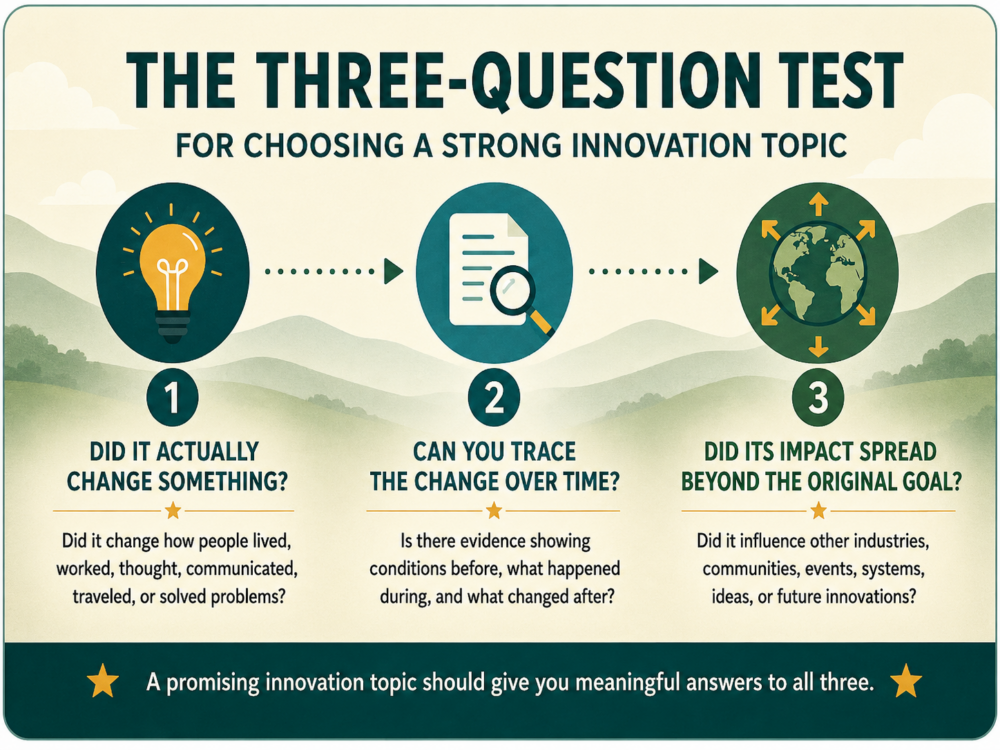
The Three-Question Test
- Did it actually change something?
- Can you trace that change over time?
- Did its influence spread beyond the original goal or immediate use?
The strongest innovation topics usually produce meaningful answers to all three questions.
A weak or incomplete answer does not automatically disqualify a topic. It is a warning to investigate further, narrow the focus, or rethink the way the topic is framed.
Question One: Did It Actually Change Something?
Do not ask only whether the innovation was useful or impressive. Ask whether it changed how people lived, worked, traveled, communicated, thought, or solved problems.
The moving assembly line did much more than help Ford build automobiles faster. It reorganized factory production, sharply reduced manufacturing time, helped lower prices, and put car ownership within reach of many more American families.
That is meaningful change.
Question Two: Can You Trace the Change Over Time?
A strong topic has a before and after that you can document with evidence.
Before mass production transformed the automobile industry, cars were expensive, labor-intensive products beyond the reach of most families. As assembly-line production spread, prices fell, automobile ownership expanded, and American communities increasingly changed around car travel.
A student could locate production records, prices, photographs, advertisements, worker accounts, newspaper coverage, and evidence of changes in transportation and daily life.
The change is not merely claimed. It can be traced.
Question Three: Did Its Influence Spread Beyond the Original Goal?
The immediate goal of the moving assembly line was straightforward: build automobiles faster and at a lower cost.
Its effects spread much farther. Assembly-line production influenced other industries, changed expectations for factory workers, encouraged mass consumption, and contributed to changes in transportation, cities, suburbs, and American daily life.
That wider influence gives the topic historical depth.
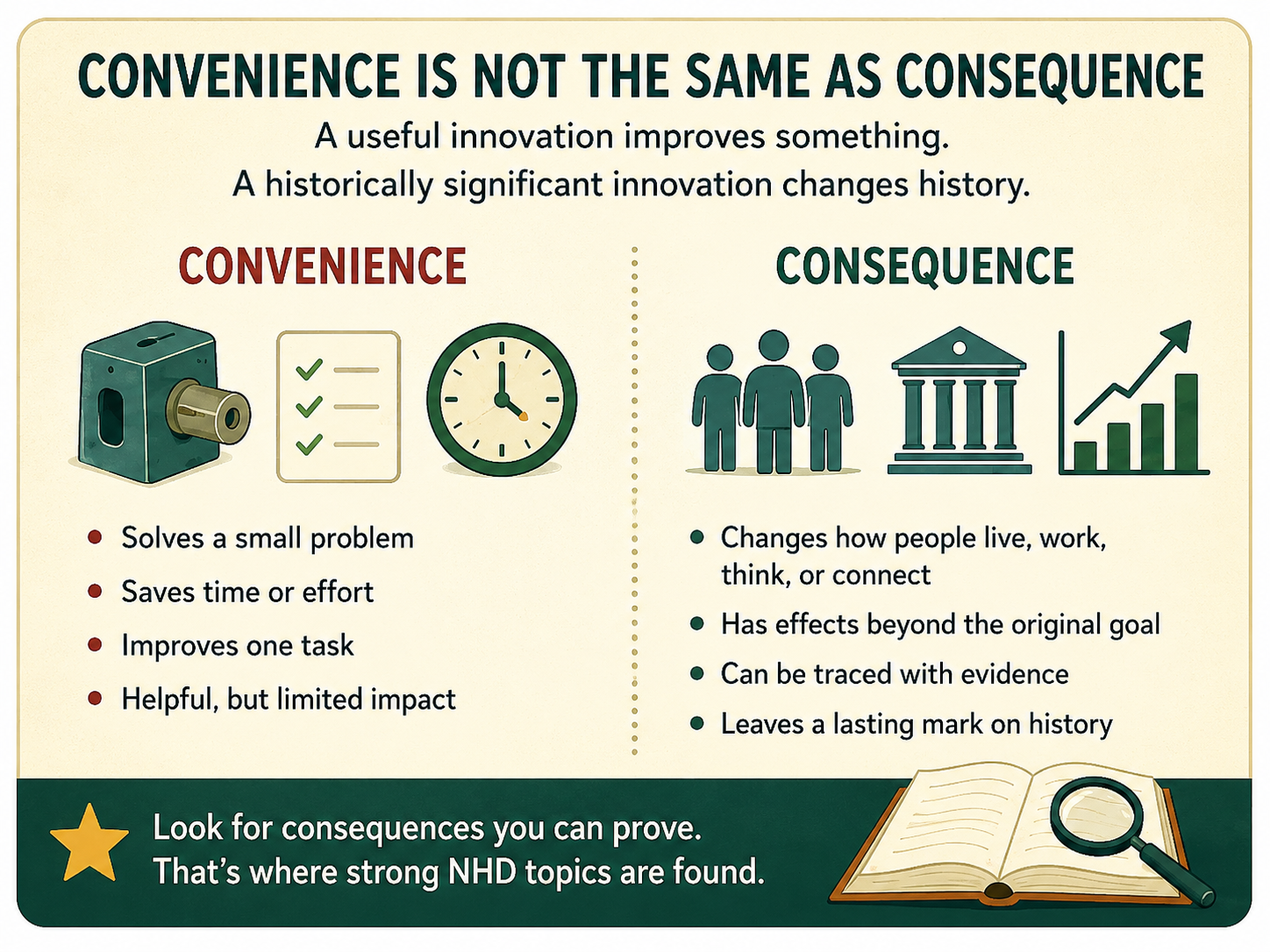
Convenience Is Not the Same as Consequence
This is where many students get caught.
An innovation may make something faster, easier, smaller, more comfortable, or more convenient. Those improvements can be real and valuable.
But improvement alone does not prove historical significance.
Return to the electric pencil sharpener. It solved a small problem. It saved time and reduced effort.
But can a student prove that it substantially changed education, industry, communication, labor, or daily life? Can the student trace important effects over time? Did its influence spread far beyond sharpening pencils?
Probably not without forcing the evidence to carry more weight than it should.
Compare that with Ford’s moving assembly line. It also made a task faster and more efficient, but the consequences spread through manufacturing, labor, transportation, consumer culture, and community development.
Both were useful.
Only one produced the kind of widespread, traceable change that can support a strong historical argument.
🔵 History Happens Help
Don’t ask only, “Is this topic interesting?” Ask, “Is there evidence of change I can actually prove?”
Almost anything becomes interesting when you examine it closely enough. National History Day, however, requires more than an interesting subject. You need a historical argument supported by evidence.
Watch the difference:
Weak approach:
“I want to do my project on the assembly line because it was an important invention.”
Stronger approach:
“The moving assembly line transformed automobile production by reducing manufacturing time and cost, but its influence spread much farther by reshaping industrial labor, consumer access, transportation, and American daily life.”
The weak version begins with importance.
The strong version explains and proves why the topic was important.
Before committing to a topic, try identifying at least one piece of evidence for each part of the test:
- What changed because of the innovation?
- What evidence demonstrates a difference between before and after?
- What wider effect, influence, or consequence followed?
History Happens Tip: The innovation gets your attention. The evidence tells you whether you have a project.
A Weak Topic May Need a Better Question
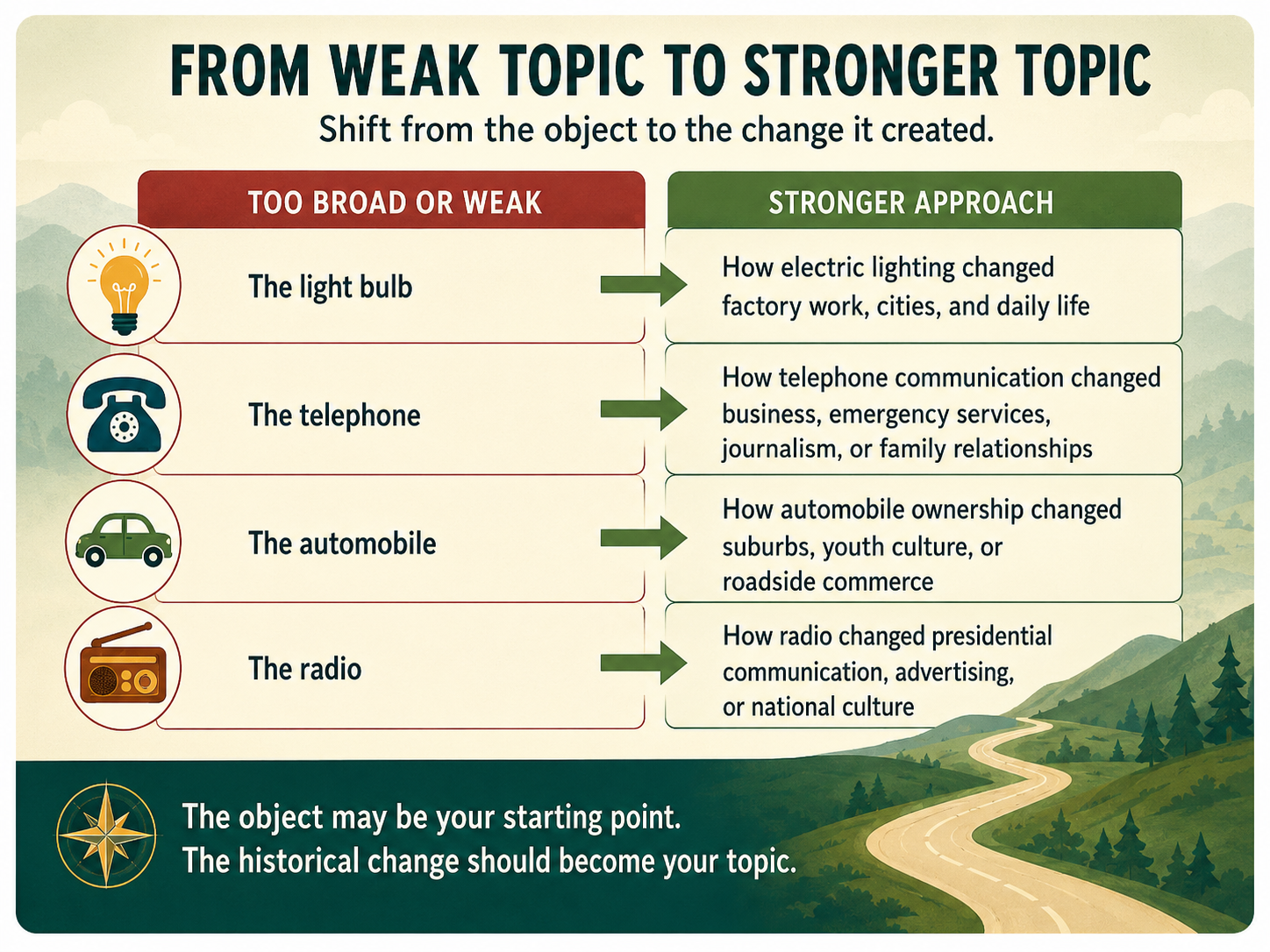
A topic that struggles with the test does not always need to be abandoned. Sometimes it simply needs to be reframed around a more specific historical change.
Suppose a student says:
“I want to do my project on the light bulb.”
The subject is historically important, but the topic is still too broad and too focused on the object itself.
The student could move through three stages:
Too broad:
The invention of the light bulb.
Better:
The development and spread of electric lighting.
Stronger:
How electric lighting changed factory work, urban life, and the hours during which Americans worked, shopped, and socialized.
The third version provides a clearer path toward historical analysis. It identifies what changed, suggests a before and after, and opens the door to evidence about labor, cities, business, safety, entertainment, and daily life.
The light bulb may be the starting point.
The historical transformation should become the project.
🟠 Your Turn
Take the innovation topic you are currently considering and run it through the test.
- Did it actually change something?
What changed in people’s lives, work, ideas, behavior, opportunities, or surroundings? - Can you trace the change over time?
What evidence could show conditions before the innovation, what happened as it spread, and what changed afterward? - Did its influence spread beyond the original goal?
Did it affect other industries, communities, events, systems, beliefs, or later developments?
Write at least one specific example beneath each question.
If your answers come quickly and lead to even more questions, your topic may have strong potential.
If one answer is weak, do not panic. Ask whether you need more research, a narrower time period, a more specific group of people, or a better question about what changed.
Then run the revised topic through the test again.
Continue Your Journey
Choosing a topic that survives the Three-Question Test gives you something worth building on, but choosing the topic is only the beginning.
Future Learning Guides in this series will help you narrow your focus, develop stronger research questions, locate meaningful evidence, build a thesis, organize your project, and prepare to explain your historical argument to judges.
For now, concentrate on getting this first major decision right.
One Final Thought
Students often think the hardest part of National History Day will be writing the thesis, finishing the annotated bibliography, designing the exhibit, editing the documentary, rehearsing the performance, or answering judges’ questions.
But one of the hardest decisions happens before the serious work begins.
It is deciding what deserves months of your attention.
Choose well, and research produces useful evidence, stronger questions, and connections you can follow. Choose poorly, and you may spend months trying to force a thin topic to support an argument it cannot carry.
No amount of polished writing or creative design can fully repair a topic that lacks meaningful, traceable historical change.
So do not ask only what sounds exciting.
Ask what changed.
Ask whether you can prove it.
Ask how far its influence traveled.
One hurdle cleared. On to the next.