
Understanding the difference between innovation and invention before you choose your topic.
Introduction
Hear “Innovation in History” and your brain does the obvious thing: it reaches for inventors. The light bulb. The airplane. The telephone. The computer. If that’s where your mind went, you’re not wrong to go there — you’re just early. It’s also exactly where a lot of students will quietly go off track before they’ve even chosen a topic.
The strongest projects this year won’t be about inventions at all, or at least not only about them. They’ll be about something bigger: how a new idea, a better system, or a smarter way of doing things changed how people lived, worked, learned, governed, or connected with each other. Get the distinction between invention and innovation straight before you pick a topic, and you’ll open up hundreds of stronger project ideas you’d otherwise walk right past.
🟢 History Happens Hurdle
Before you read on, see if you can clear this hurdle.
Which of the following best represents this year’s theme of Innovation?
A. Thomas Edison invents the light bulb.
B. Henry Ford develops the moving assembly line.
C. Alexander Graham Bell invents the telephone.
D. The Wright brothers invent the airplane.
Take your best guess before reading on. (We’ll come back to it.)
The Answer Might Surprise You
If you picked B, you’re already thinking like a historian.
If you picked something else, don’t sweat it — you just made the same assumption almost every student makes the moment they hear this year’s theme.
All four options look like they belong. Each one genuinely changed history. But NHD didn’t choose “Inventions in History.” It chose Innovation in History. That word choice was deliberate.
An invention is something new under the sun. An innovation is usually something else entirely: taking what already exists and making it better, cheaper, faster, or more widely available. Sometimes an innovation grows out of an invention. Just as often, it doesn’t touch invention at all.
Henry Ford didn’t invent the automobile — the automobile already existed. What Ford changed was how cars got built. By reorganizing the manufacturing process into a moving assembly line, he collapsed production time and cost so dramatically that a machine once reserved for the wealthy became something millions of ordinary Americans could actually own. That’s not a better factory. That’s a different country — different commutes, different suburbs, different daily life.
That ripple effect is what makes the assembly line a textbook example of innovation, and it points to the real question NHD wants you asking:
How did people find a better way to solve a problem, and how did that change history?
Looking at Innovation Through the National History Day Lens
Once the invention/innovation distinction clicks, something shifts in how you look at the past.
You start noticing that most of history’s real turning points weren’t triggered by something brand-new appearing out of nowhere. They happened because someone took what already existed and found a better way to use it, run it, or share it. Sometimes that involved an invention. Often it didn’t.
Innovation, at its core, is change that matters. It takes an idea, a process, a system, or even just a way of thinking, and improves it enough to leave a lasting mark.
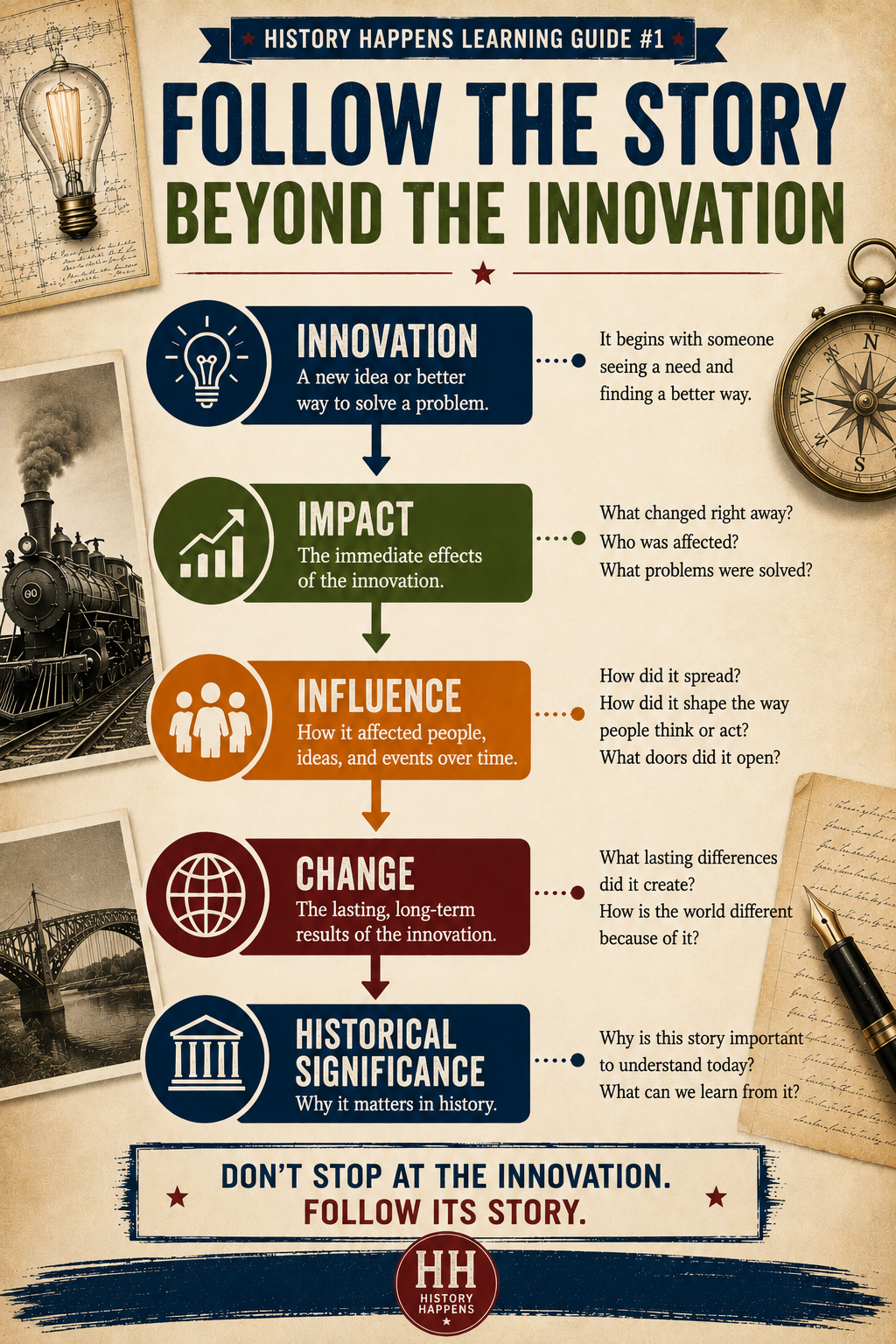
But NHD isn’t stopping at “innovation.” The full theme is Innovation in History: Impact, Influence, Change — and those three words are doing the real work. An innovation on its own isn’t a project. What matters is what happened because of it:
- Impact — What did it change in people’s day-to-day lives?
- Influence — What did it shape in the events, people, or ideas that came after?
- Change — What shifted, right away or over time?
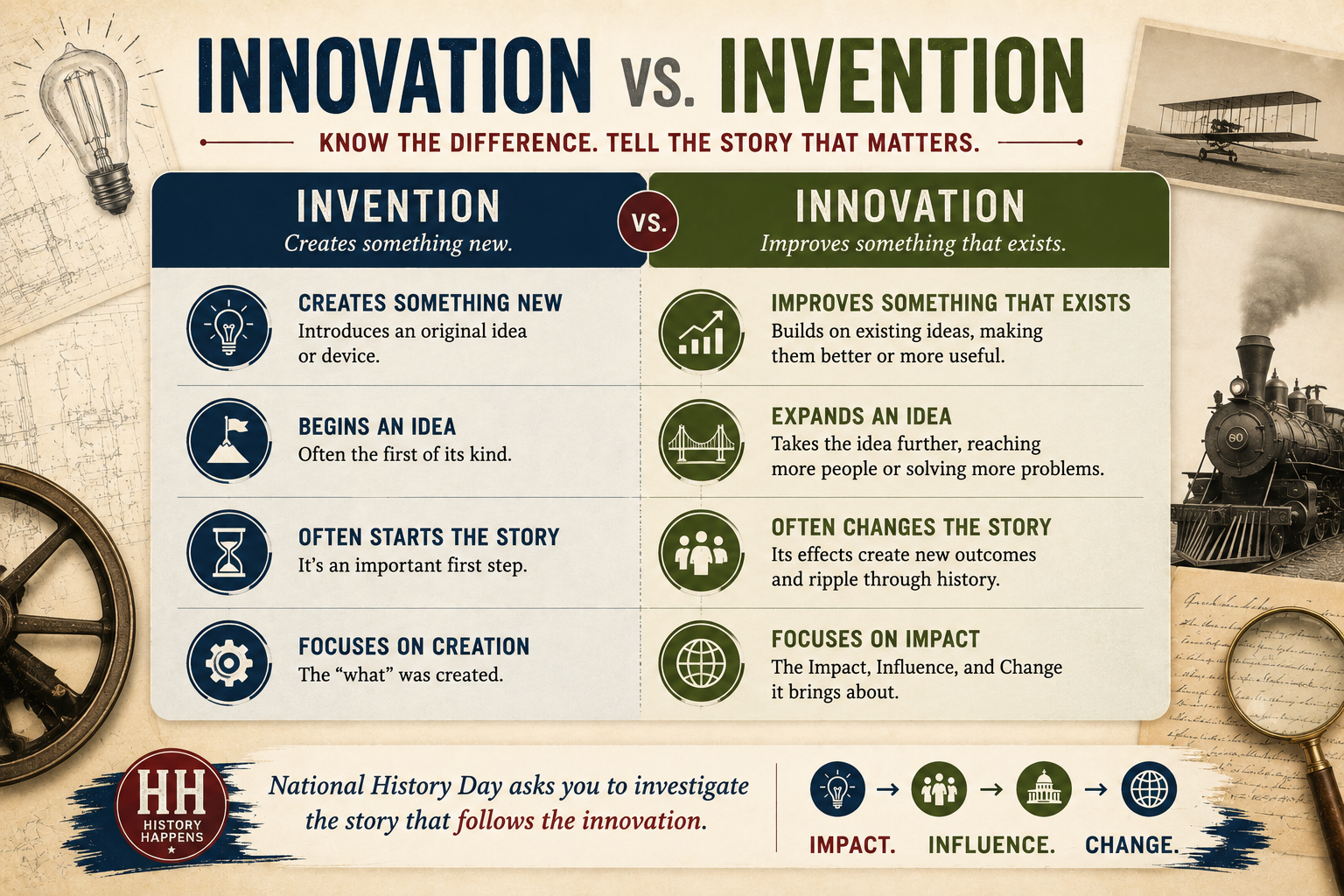
Back to Ford: he didn’t invent the automobile — he changed how automobiles were made. The impact was affordability for ordinary families. The influence spread across industries, as manufacturers everywhere adopted assembly-line production. The change reached transportation, cities, labor, and American daily life for generations.
That same pattern shows up across history, over and over:
- The Interstate Highway System didn’t invent roads — it reshaped travel, commerce, and where and how Americans lived.
- Container shipping didn’t invent ships — it remade global trade by making the movement of goods dramatically faster and cheaper.
- The GI Bill didn’t invent education — it threw open college doors for millions of veterans and reshaped the economic future of entire families.
Notice the pattern? Each of these solved a real problem. Each had impact. Each had influence. Each set off change historians can still trace today.
That’s what NHD wants you investigating. Stop asking “What was invented?” and start asking “What changed because of it?” That question is where outstanding projects begin.
🔵 History Happens Help
Don’t ask, “Is this an innovation?” Ask, “Is there a story here?”
The easiest mistake to make this year is falling in love with the innovation itself and stopping there. But the innovation is only the opening scene — what makes a project memorable is what happens after it.
Take the assembly line again. If your project just described how it worked, when it launched, and how many cars rolled off the line, you’d have a decent report. You would not have an outstanding NHD project.
Now run the same topic through this year’s lens. Instead of “How did the assembly line work?” ask:
- What problem was Ford actually trying to solve?
- How did it change life for the average American family?
- Which other industries copied the idea?
- Were there costs or consequences nobody expected?
- How did this innovation keep shaping manufacturing decades later?
The first set of questions describes an innovation. The second set investigates its impact, influence, and change — which is precisely what judges are scoring.
So as you weigh topics this year, hold onto this:
Don’t choose a topic because the innovation is interesting. Choose it because the story that follows is even more interesting.
If an innovation changed lives, shaped what came next, or set off change that’s still traceable today, you’ve found something worth building a project around.
History Happens Tip: The innovation gets your attention. Its impact, influence, and change tell the story.
🟠 Your Turn
One of the best things about NHD is that there’s no single “right” topic. There are hundreds of them — maybe thousands — waiting to be found.
Before you move on, spend a few minutes on three topics that interest you. They can be ideas you’ve already been circling, or brand new ones this guide just sparked. For each one, try answering:
- What was the innovation?
- What impact did it have?
- How did it influence people, events, or later developments?
- What change resulted because of it?
Don’t worry if the answers don’t come easily yet — that’s what research is for. But you’ll likely notice something quickly: some topics are interesting but thin, with little left to dig into. Others come alive, because they’re sitting on a rich vein of impact, influence, and change waiting to be uncovered.
Those are usually the topics that become the strongest projects.
Continue Your Journey
This is the first Learning Guide in our series for this year’s theme. Over the coming months, we’ll keep adding History Happens guides to help you choose a topic, sharpen your research, write a stronger thesis, organize your evidence, and prepare for your judges’ interview — check back often as new guides go up.
One Final Thought
Every NHD season starts the same way: students hear the theme, brainstorm a handful of ideas, and wonder where to begin.
The students who end up with outstanding projects usually aren’t the ones who walked in knowing the most history. They’re the ones who learned to ask better questions.
This year’s theme is an invitation to look past what was invented and dig into what actually changed history — to trace how an innovation created impact, exercised influence, and produced change that lasted. Start there, and you’re already thinking like a historian.
One hurdle cleared. On to the next.