A simple way to turn a short list of possible topics into the one your student will actually run with.
Introduction
In Guide #3, we asked you to sit down with your child for fifteen minutes and name three things that genuinely interest them, then ask a single question about each: what changed because of this.
For some families, that exercise ends with one clear favorite. For plenty of others, it ends with two or three ideas that all seem to hold up, and no obvious way to choose between them.
That’s a good problem to have, and it’s also where a lot of families lose momentum. Under pressure to just pick something, the decision often comes down to whichever topic the student feels most excited about that day, or whichever one already has the most information online. Neither of those tells you which topic will actually hold up once real research starts.
If your family is still choosing, or having second thoughts about a pick, this guide is for you. It gives you a small, repeatable way to compare candidates side by side and let the evidence, not the mood of the moment, make the call.
🟢 History Happens Hurdle
Before you read on, see if you can clear this hurdle.
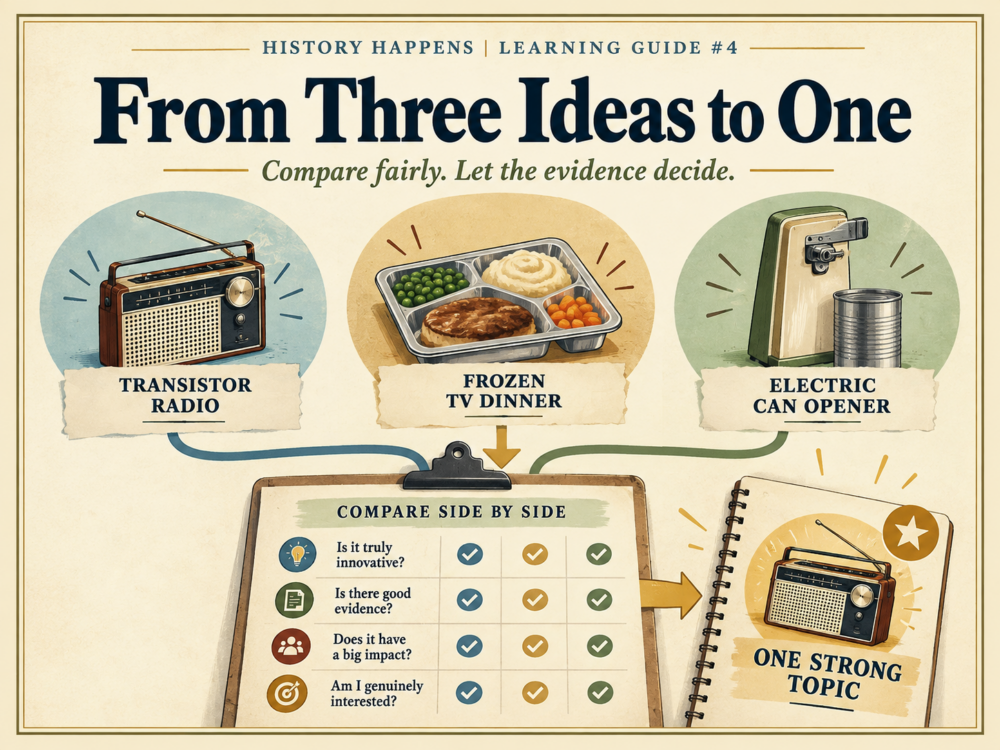
A student has narrowed the search to three possible topics: the transistor radio, the frozen TV dinner, and the electric can opener. All three sound reasonable. None sounds obviously stronger than the others. What’s the best way to choose?
A. Pick whichever one the student still feels most excited about after a few days.
B. Pick whichever one already has the most information available with a quick search.
C. Run each one through the same test and compare the results side by side.
D. Have the student write a paragraph on each and see which one comes easiest.
Take your best guess before reading on. (We’ll come back to it.)
The Answer Is C
Excitement fades and shifts as soon as research gets hard, so it isn’t a reliable test. How much shows up in a quick search says more about how well documented a topic already is online than whether it can support a full project. And how easily a paragraph comes says more about what the student already knows off the top of their head than what the evidence can actually support.
A, B, and D each measure something real, just not the thing that predicts a strong project. Comparing candidates on the same standard is the only approach that tells you which topic will still be standing when the research gets hard.
The Side-by-Side Method
Guide #2 gave you the Three-Question Test: did it actually change something, can you trace that change over time, and did its influence spread beyond the original goal.
Up to now, you’ve probably used that test on one topic at a time. When you’re choosing between several candidates, though, testing them one at a time doesn’t tell you which one to pick. You need to run all of them through the same three questions, on the same day, and compare the answers directly.
Here’s what that looks like with the three topics from the hurdle above.
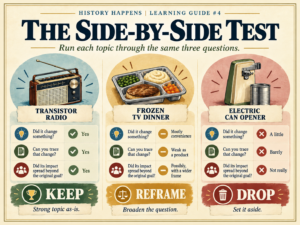
Candidate One: The Transistor Radio
Did it change something? Yes. Radios became small and cheap enough that people, especially teenagers, could carry one anywhere and listen to what they wanted without asking permission or sharing the family’s living room set.
Can you trace it? Yes. Sales figures, price drops, and ownership rates give you a way to measure the before and after, and so does the sudden reach of music that parents weren’t necessarily choosing for their kids.
Did its influence spread beyond the original goal? Yes. It reshaped the music industry, gave teenagers a new kind of independence, and put music and news directly in the hands of young listeners.
Verdict: Keep. All three questions produce specific, checkable answers.
Candidate Two: The Frozen TV Dinner
Did it change something? On its own, mostly convenience. It saved time in the kitchen.
Can you trace it? Weak, if the topic stays framed around the product itself. There isn’t much of a dramatic before and after in just the dinner tray.
Did its influence spread beyond the original goal? Possibly, but only with a different frame. The real story may not be the product. It may be the broader shift toward convenience food and what that shift did to family schedules and grocery habits.
Verdict: Reframe. This is the same move Guide #2 made with the light bulb: move from “the invention of the frozen dinner” to “how convenience food changed the American family dinner.”
Candidate Three: The Electric Can Opener
Did it change something? It made opening a can easier. That’s close to the whole story.
Can you trace it? Barely. Sales figures would mostly tell you how many kitchens bought one.
Did its influence spread beyond the original goal? Not that we can find. Nothing obvious reaches beyond the kitchen counter.
Verdict: Drop. Unlike the frozen dinner, no bigger story is waiting behind this one that we can find. Some topics reframe well. Others stay small. If your student finds a wider story, run it through the test again.
Reading the Results
Once you’ve run every candidate through the test, you’ll usually land in one of three places:
Keep. The topic gives clear, specific answers to all three questions as it stands. Move forward with it.
Reframe. The topic has something real underneath it, but the current framing is too narrow or too focused on the object itself. Widen the question before deciding whether to keep it.
Drop. The topic doesn’t hold up, and no reasonable reframe rescues it. That’s useful information, not a failure.
If more than one candidate lands on Keep, let your student choose between those, based on genuine interest and which one they can find the most solid evidence for. The test narrows the field. It doesn’t have to make the final call by itself.
🔵 History Happens Help
Your job here isn’t to pick the topic. It’s to help your student compare fairly instead of deciding by mood or convenience.
A few ways to do that:
- Run every remaining candidate in one sitting. Comparing them on the same day, side by side, keeps the comparison fair.
- Let your student write the answers, even messy ones. The point is what they can find evidence for, not a polished paragraph.
- Treat “Reframe” as progress, not a setback. A topic that needs a wider frame usually turns into a stronger project than one that passed the test on the first try.
- Resist breaking the tie yourself. If two topics both land on Keep, the choice between them belongs to your student.
History Happens Tip: Don’t ask which topic is more fun. Ask which one gives your student the most to prove.
🟠 Your Turn
Gather the ideas your student named back in Guide #3, along with anything new that’s come up since. Run each one through the Three-Question Test from Guide #2, and label it Keep, Reframe, or Drop.
If everything lands on Drop, that’s not a dead end. It just means the questions worked and it’s time to name a few new ideas and try again.
If even one lands on Keep, or turns into a strong Reframe, your student has a topic worth committing to.
Continue Your Journey
Once a single topic survives the test, two decisions come next: which NHD category actually fits the evidence, the student, and the story, and how to turn that topic into a specific research question the whole project can be built around. Future guides in this series will walk through both.
One Final Thought
Choosing a topic often feels like it should be one decision, made once, at the very beginning. In practice, it’s usually a handful of smaller decisions, made in sequence, each one narrowing the field a little further.
That’s not a sign your family is doing it wrong. It’s what the process actually looks like when it’s working.
The goal was never to guess the perfect topic on the first try. It was to compare fairly and let the evidence decide.
One hurdle cleared. On to the next.
